Show summary Hide summary
The Causeway Coast delivers theatrical weather and stark coastal scenery that can change in minutes — and that very volatility is part of its appeal. Over a long weekend based in Ballycastle, I found wildlife-rich islands, ancient stone formations and a string of small, characterful stops that reward slow exploration.
Staying in Ballycastle: views and a low-carbon base
I chose Ballycastle as a base rather than attempting the entire 200km Causeway Coastal Route in one go. From my hilltop room at the Salthouse Hotel, Rathlin Island and the cliffs of Fair Head sat like moving sketches on the horizon.
The hotel is notable for its sustainability credentials. It runs on energy from an on-site wind turbine and solar array and draws water from its own well, a point of pride for staff who were happy to refill water bottles and explain the practices that reduce guests’ footprint.
Out to sea: Rathlin Island and seabird colonies
An outing with Kintra Boat Tours offered the most immediate sense of how quickly conditions can turn. Storm Dave blew in from the Atlantic during my visit, and the skipper, Charles — a Scotsman who bought a boat and settled in Ballycastle three decades ago — adjusted our plans to avoid the worst of it.
As we crossed, the daily ferry to Rathlin passed us carrying passengers and, strikingly, a full-sized bin lorry on its weekly run to collect rubbish from the island’s roughly 140 residents. It was a practical reminder that these remote communities require everyday services.
Rathlin hosts one of the north of Ireland’s largest seabird colonies. In summer, about 2,500 puffins nest here alongside guillemots, razorbills and kittiwakes, all crowded onto narrow cliff ledges. Dawn, a marine biologist from Louth who joined the trip, helped identify species from the boat while our skipper narrated stories of the shoreline’s history — including tiny sea caves once used to land contraband.
We didn’t spot dolphins on this crossing, though they and larger visitors such as whales and basking sharks are known to pass these waters later in the season.
Whiskey, hedges and a cosy supper
When the sea trip ended, I moved inland to Old Bushmills Distillery. Official records show a licence granted in 1608, and the visitor tour lays out the slow, careful craft behind the spirit. The tasting that follows feels earned after fresh sea air and a blustery morning.
A short detour took me to the Dark Hedges, the beech avenue that fans recognise from television. In late winter the trees looked bare and skeletal; it’s a location that benefits from the fullness of summer light.
That evening, dinner at the Bushmills Inn made a contrast with the day’s wind and stone. The dining room, set in the old coach house and stables, paired timber ceilings and Victorian-era booths with menus focused on local seafood.
The Giant’s Causeway: legend and geology
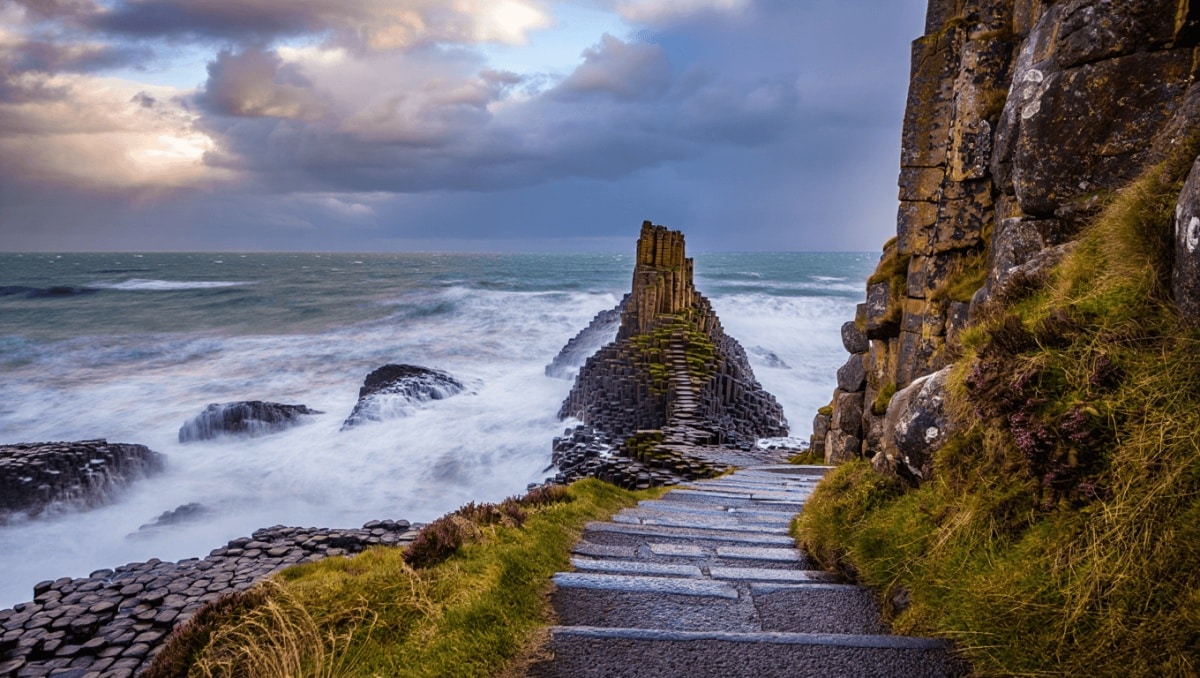
No visit to this stretch of coast is complete without the hexagonal columns of the Giant’s Causeway. The visitor centre, designed by Heneghan Peng Architects, echoes the site’s fractured basalt in its low, angular form.
A guide led our group down to the shore, first recounting the folk tale of Fionn Mac Cumhaill and a bridge to Scotland, then explaining the scientific story: volcanic eruptions about 60 million years ago cooled and cracked to form the interlocking columns seen today. Walking across the stones, the landscape felt elemental — wind, sea and rock in close drama.
After the visit, lunch at the nearby Causeway Hotel provided shelter from the elements. The afternoon was a series of quieter stops: the cliff-top ruins of Dunluce Castle, the long sweep of Whitepark Bay, and Ballintoy Harbour, familiar to many as a filming location.
I had planned to cross the Carrick-a-Rede Rope Bridge, originally erected by salmon fishermen. High winds kept it closed that day, so I watched the island it links from the shore and continued along the coast.
Fair Head and a private, working landscape
Driving back toward Ballycastle, the road climbs and the view opens to the 200-metre cliff known as Fair Head. The following day, with winds eased, I reached the McBride family’s privately owned farm, which has been worked by the family for nearly 300 years.
The farm track and a small car park make the approach feel intimate rather than curated. Far from fenced viewing platforms, the cliffs here are open and raw; I kept a respectful distance and let the scene — Rathlin Island offshore, the Mull of Kintyre close across the water — register at its own pace.
A weekend here is shaped by weather as much as by place: fast-changing skies, sea spray, and wide horizons. For visitors willing to slow down, the Causeway Coast rewards patience with wildlife, geology and a string of authentic local encounters.
The details
Deirdre Mullins visited as a guest of Discover Northern Ireland. More information about the Causeway Coast is available at discovernorthernireland.com. You can follow her travels on Instagram at @deirdremullins. The views expressed are those of the author and do not reflect RTÉ’s positions.